

Master Makhaarij and Sifaat Online: A Guide for Non-Arabic Speakers
The best way for non-Arabic speakers to master Tajweed is by focusing on Makharij Al-Huruf (articulation points), understanding the characteristics of letters (Sifaat), and practicing consistently with a certified native Arab tutor. Online Tajweed classes provide the necessary 1-on-1 feedback to correct pronunciation errors instantly and preserve the Quran’s true meaning.
The Problem: For English speakers and non-native Muslims living in the West, learning to recite the Quran correctly is a profound struggle. The Arabic alphabet contains unique sounds—especially those originating deep in the throat—that simply do not exist in the English language.
The Agitation: Trying to learn these complex sounds from YouTube videos or unqualified local tutors often leads to deeply ingrained mistakes. A slight mispronunciation, known as Lahn Jali (major error), can completely change the meaning of the words of Allah. For example, pronouncing the letter “Qaf” (ق) as a “Kaf” (ك) changes the word Qalb (Heart) into Kalb (Dog). This is a terrifying prospect for any devout Muslim seeking to recite the Quran with reverence.
The Solution: You do not need to speak Arabic fluently to recite the Quran perfectly. The key is to Master Makhaarij and Sifaat Online through structured, personalized guidance. At Quran Academy, our Al-Azhar certified native tutors specialize in breaking down complex Tajweed techniques into simple, actionable steps for non-Arabic speakers.
What are Makharij Al-Huruf and Sifaat?
To recite the Quran beautifully, you must understand the mechanics of Arabic pronunciation.
Makharij Al-Huruf (Articulation Points): This refers to the exact physical location in the mouth, throat, or nasal cavity where the sound of a specific letter originates. If you press the wrong “key” in your mouth, you produce the wrong letter.
Sifaat (Characteristics): These are the inherent qualities of the letter. Does the sound echo? Is it heavy (filling the mouth) or light? Does air flow with it or stop abruptly?
Understanding the combination of a letter’s origin (Makhraj) and its quality (Sifah) is the absolute foundation of Tajweed.
5 Basic Tajweed Techniques for Non-Arabic Speakers
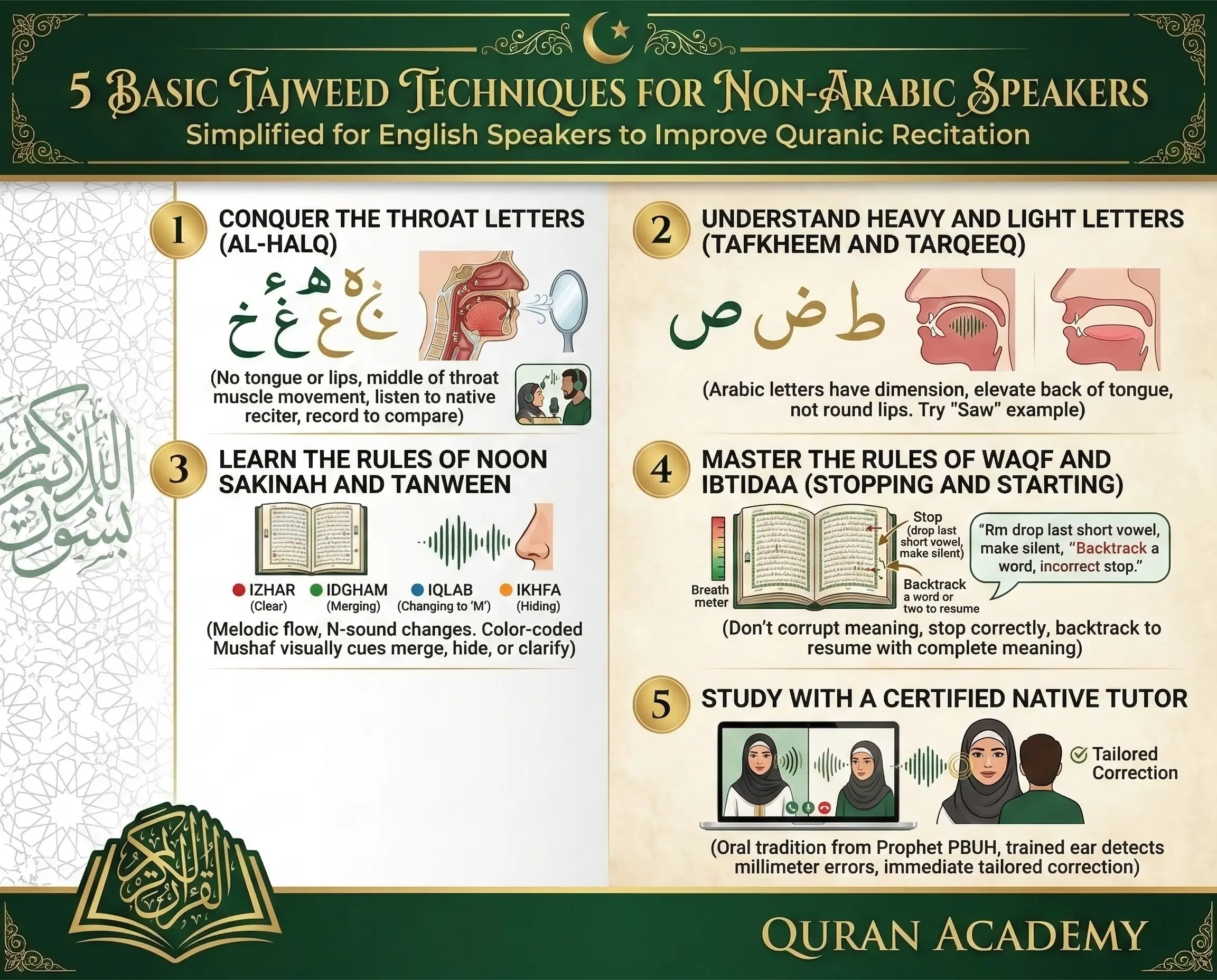
Here are the foundational techniques simplified for English speakers to improve their Quranic recitation:
1. Conquer the Throat Letters (Al-Halq)
The hardest letters for Westerners are usually the six throat letters: ء (Hamza), ه (Haa), ع (Ain), ح (Haa), غ (Ghain), and خ (Kha).
The Technique: Stop trying to use your tongue or lips for these. For instance, the letter ح (Haa) comes from the middle of the throat and sounds like a sharp, breathy exhale—similar to fogging up a mirror. The best way to master this is by listening to a native reciter, slightly exaggerating the throat muscle movement, and recording yourself to compare the sounds.
2. Understand Heavy and Light Letters (Tafkheem and Tarqeeq)
English letters generally have a flat sound, but Arabic letters have dimension.
Heavy Letters (Tafkheem): Letters like ص (Saad), ض (Daad), and ط (Taa) require you to elevate the back of your tongue towards the roof of your mouth, creating a full, echoing sound inside the mouth.
The Technique: Try saying the English word “Saw” to feel a slight heaviness, then compare it to the Arabic ص. Never round your lips to make a letter heavy; the work is done entirely by the back of the tongue.
3. Learn the Rules of Noon Sakinah and Tanween
When a silent ‘N’ sound (Noon Sakinah or Tanween) meets other letters, its pronunciation changes to maintain the melodic flow of the Quran.
Izhar (Clear): Pronounce the ‘N’ normally.
Idgham (Merging): Merge the ‘N’ into the next letter.
Iqlab (Changing): Change the ‘N’ into an ‘M’ sound.
Ikhfa (Hiding): Hide the ‘N’ sound, creating a nasal hum (Ghunnah).
The Technique: For beginners, using a color-coded Tajweed Mushaf (Quran) is incredibly helpful. The colors visually cue your brain to merge, hide, or clarify the sound before your tongue even reaches the word.
4. Master the Rules of Waqf and Ibtidaa (Stopping and Starting)
Knowing how to pronounce a word is only half the battle; knowing when to stop and how to resume is equally critical.
The Technique: The Rules of Waqf and Ibtidaa (Stopping and Starting) dictate that you cannot stop in the middle of a sentence in a way that corrupts the meaning. If you run out of breath, you must stop correctly (usually by dropping the last short vowel and making it silent), and then backtrack a word or two to resume the recitation with a complete meaning.
5. Study with a Certified Native Tutor
Theoretical knowledge from books cannot correct your physical pronunciation. Tajweed is an oral tradition passed down from the Prophet (PBUH).
The Technique: Enroll in an online Tajweed course with a certified native Arab tutor. A trained ear can instantly detect if your tongue is a millimeter off its correct Makhraj and provide immediate, tailored correction.
Why Native Tutors Are Essential for Tajweed Mastery
Many platforms cut costs by hiring non-native speakers. However, achieving true proficiency requires learning from scholars who have inherited the language and the Quranic sciences.
At Quran Academy, every tutor holds a verifiable Ijazah (a continuous chain of certification). This is your guarantee that you are not just learning “how to read,” but you are preserving the divine authenticity of the Holy Quran. Whether you are an adult starting from scratch or a parent looking for Noorani Qaida courses for beginners, our 1-on-1 personalized sessions ensure rapid, accurate progress.





Howdy! I could have sworn Iíve been to this blog before but after looking at a few of the posts I realized itís new to me. Anyways, Iím certainly pleased I came across it and Iíll be bookmarking it and checking back frequently!
An attention-grabbing dialogue is value comment. I believe that you must write more on this matter, it won’t be a taboo topic however generally persons are not sufficient to talk on such topics. To the next. Cheers
I am only commenting to let you understand what a really good discovery my cousin’s daughter had viewing yuor web blog. She picked up plenty of things, which included what it is like to have a marvelous teaching mindset to have folks quite simply understand certain complex topics. You undoubtedly surpassed readers’ expected results. Many thanks for giving such insightful, trusted, informative and in addition cool tips about this topic to Janet.