

Quran Recitation Rules: A Complete Beginner's Guide to Tajweed
Reciting the Holy Quran is not just about reading Arabic words from a page; it is a profoundly spiritual act of vocalizing the exact words of Allah as they were revealed to Prophet Muhammad (peace be upon him). To achieve this beautiful, precise articulation, Muslims follow a specific science known as Tajweed.
The word Tajweed (تجويد) literally means “to beautify” or “to perfect.” It encompasses a complete set of Quran recitation rules designed to ensure every single letter is pronounced correctly, with its proper characteristics and rhythm.
For beginners, especially non-native Arabic speakers, looking at Tajweed rules can initially feel intimidating. But don’t worry! This comprehensive guide by Quran Academy will break down the fundamental Quran recitation rules into simple, understandable concepts, helping you start your journey toward beautiful and accurate recitation.
Why Are Tajweed Rules So Important?
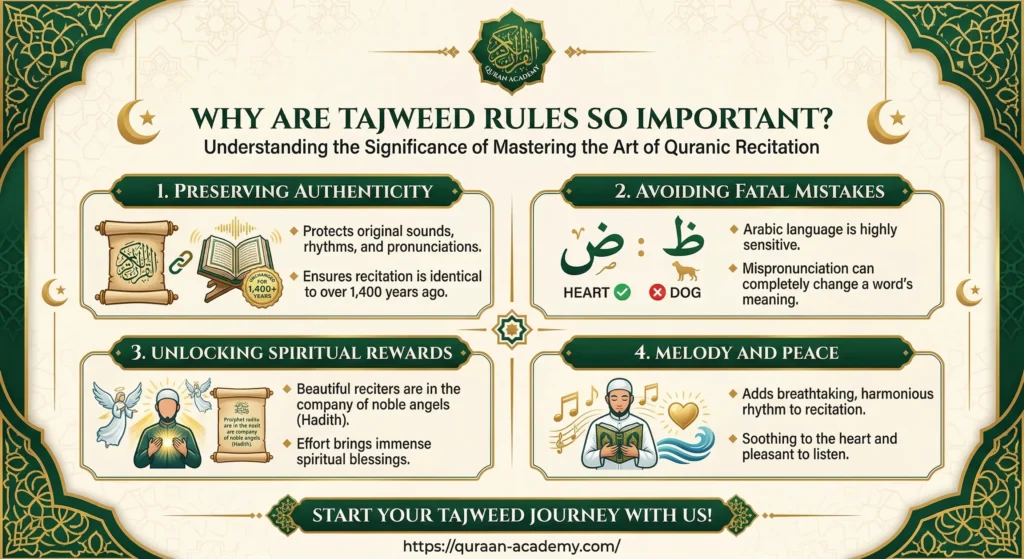
Learning Tajweed is considered a communal obligation (Fard Kifayah), but reciting the Quran correctly is a deeply personal responsibility. Here is why mastering these rules is a big deal:
Preserving Authenticity: The Quran was revealed with very specific sounds, rhythms, and pronunciations. Tajweed ensures the Quran is recited today exactly as it was over 1,400 years ago, protecting its original form.
Avoiding Fatal Mistakes: The Arabic language is highly sensitive. Mispronouncing a single letter or stretching a vowel incorrectly can completely change the meaning of a word. When reciting the word of God, accuracy is paramount.
Unlocking Spiritual Rewards: The Prophet (PBUH) said that the one who recites the Quran beautifully and smoothly will be in the company of the noble angels. The effort you put into learning Tajweed brings immense spiritual blessings.
Melody and Peace: Tajweed naturally adds a breathtaking, harmonious rhythm to the recitation, making it deeply soothing to the reciter’s heart and pleasant for anyone listening.
7 Fundamental Quran Recitation Rules You Must Know
While the science of Tajweed is deep, every beginner will encounter these foundational rules:
1. Makharij al-Huruf (مخارج الحروف) – Articulation Points
Before applying any advanced rules, you must know exactly where each Arabic letter originates. This is called the Makhraj. For example, the letter ‘ع’ (Ayn) comes from the middle of the throat, while ‘ق’ (Qaaf) comes from the very back of the tongue. Mastering these points stops letters from sounding like English equivalents.
2. Sifat al-Huruf (صفات الحروف) – Letter Qualities
Beyond origin, letters have distinct personalities or qualities:
Heavy Letters (Tafkheem): Letters like (ص, ض, ط, ظ) must be pronounced with a full, echoing mouth.
Light Letters (Tarqeeq): Most other letters are pronounced softly, with a flat tongue.
Qalqalah (قلقلة): Five specific letters (ق, ط, ب, ج, د) create a bouncing or echoing sound when they carry no vowel (a Sukoon).
4. Meem Sakinah Rules (أحكام الميم الساكنة)
Similar to the Noon rules, these three rules dictate how a silent ‘M’ (مْ) behaves when it encounters other specific letters, either by merging, hiding, or remaining clear.
6. Ghunnah (غنة) – The Nasal Sound
Ghunnah is a beautiful, soft, humming sound that originates from the nasal cavity. It is an essential characteristic of the letters Noon (ن) and Meem (م) when they are emphasized (have a Shaddah).
7. Waqf and Ibtida’ (الوقف والإبتداء) – Stopping and Starting
You cannot simply stop reciting when you run out of breath. Stopping mid-sentence might create a contradictory meaning! These rules, guided by tiny symbols above the Quranic text, tell you exactly where it is mandatory to stop, permissible to pause, or forbidden to break the flow.
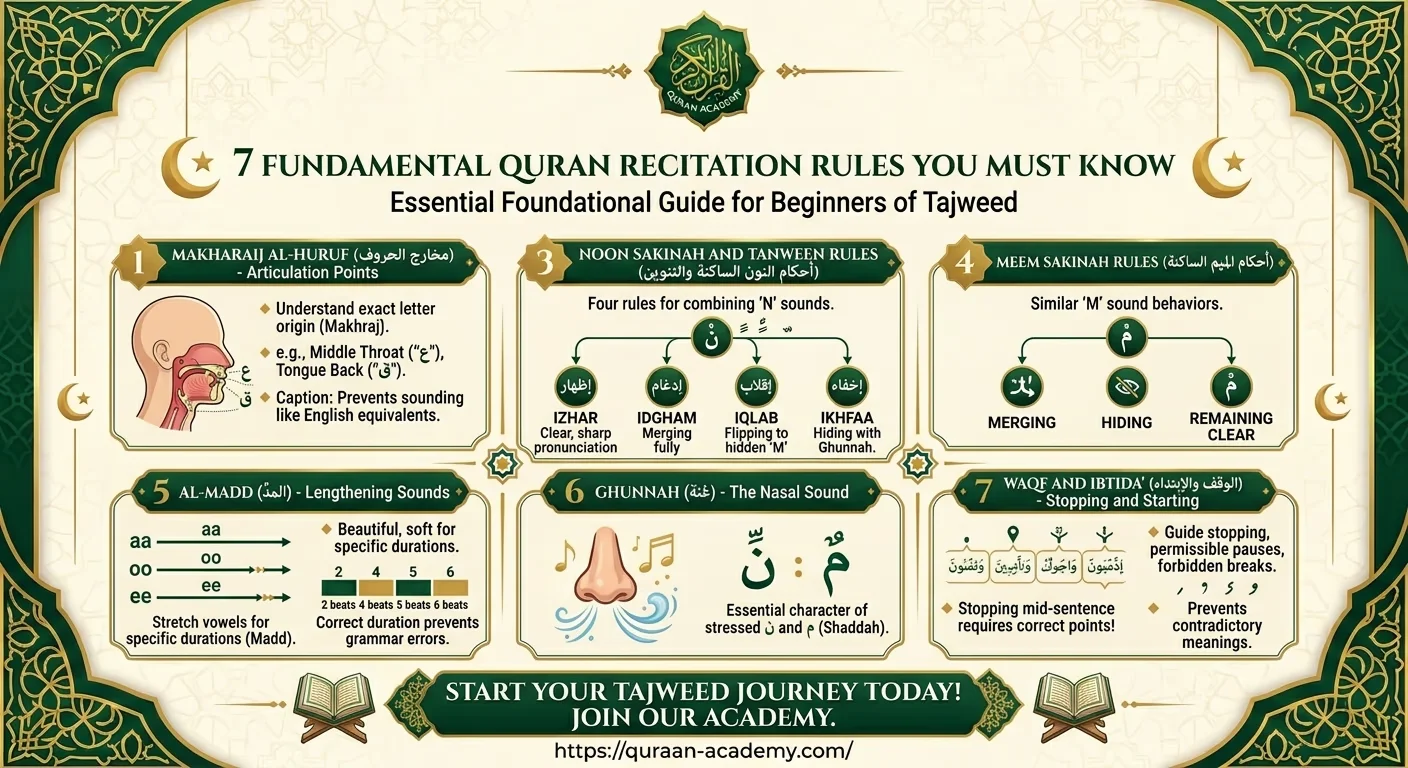
3. Noon Sakinah and Tanween Rules (أحكام النون الساكنة والتنوين)
What happens when a silent ‘N’ sound (نْ) or a double vowel (Tanween: ً ٍ ٌ ) meets the next letter? There are four strict rules:
Izhar (إظهار): Clear, sharp pronunciation without any nasal hum.
Idgham (إدغام): Merging the ‘N’ sound completely into the following letter.
Iqlab (إقلاب): Flipping the ‘N’ sound into a hidden ‘M’ sound.
Ikhfaa (إخفاء): Hiding the ‘N’ sound and replacing it with a nasal hum (Ghunnah).
5. Al-Madd (المدّ) – Lengthening Sounds
Arabic has short and long vowels. Madd rules tell you exactly how long to stretch certain sounds (like ‘aa’, ‘oo’, ‘ee’). Depending on the rule, you might stretch a vowel for 2, 4, 5, or even 6 beats. Shortening a 4-beat Madd can change the grammatical meaning of the sentence!
Common Mistakes in Quran Recitation (And How to Fix Them)
Mistakes in Tajweed are categorized into two types. Knowing them helps you avoid them:
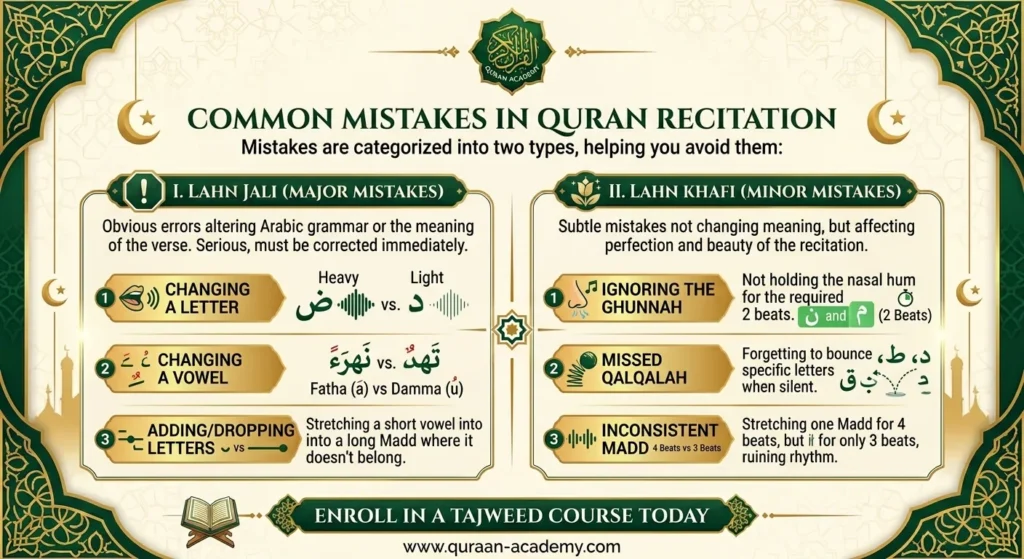
I. Lahn Jali (Major Mistakes)
These are obvious errors that alter the Arabic grammar or the meaning of the verse. They are serious and must be corrected immediately.
Changing a Letter: Pronouncing a heavy ‘ض’ (Dhaad) as a light ‘د’ (Dal).
Changing a Vowel: Reading a word with a Fatha (a) instead of a Damma (u).
Adding/Dropping Letters: Stretching a short vowel into a long Madd where it doesn’t belong.
II. Lahn Khafi (Minor Mistakes)
These subtle mistakes do not change the meaning but affect the perfection and beauty of the recitation.
Ignoring the Ghunnah: Not holding the nasal hum for the required 2 beats.
Missed Qalqalah: Forgetting to bounce the specific letters when they are silent.
Inconsistent Madd: Stretching one long vowel for 4 beats, but another for only 3 beats, ruining the rhythm.
How to Learn Tajweed Easily and Effectively
You cannot master Quran recitation rules merely by reading a book; it requires practice and a trained ear. Here is the best path to success:
Start with Noorani Qaida: If you are a beginner, do not jump straight into the Quran. The Noorani Qaida systematically teaches you the alphabet, pronunciation, and basic Tajweed rules step-by-step.
Listen to Expert Reciters: Tune into renowned Qaris (like Sheikh Al-Husary or Minshawi). Listen to their pacing, heavy letters, and beautiful flow.
Find a Qualified Teacher: This is non-negotiable for true mastery. An expert teacher can listen to your recitation, catch the subtle Lahn Khafi mistakes, and physically explain how to position your tongue.
At Quran Academy, our certified native Arab tutors specialize in taking complete beginners and transforming them into confident, accurate reciters. We offer interactive 1-on-1 online classes tailored to your pace.
Frequently Asked Questions (FAQs)
Tajweed refers to the precise set of linguistic and phonetic rules that govern the proper pronunciation and intonation of Quranic verses. It ensures that readers articulate every letter correctly from its proper origin point, maintaining the authentic beauty, rhythm, and pure meaning of the Holy text.
The timeline varies based on your dedication and guidance. With consistent practice and an expert tutor, a complete beginner can learn the Arabic alphabet and basic reading rules (Noorani Qaida) in 2 to 4 months. Mastering advanced Tajweed rules and reciting fluently can take 1 to 2 years of continuous, rewarding practice.
Proper pronunciation is vital because the Arabic language is highly specific. Pronouncing a ‘ح’ (deep throat H) as a regular ‘هـ’ (English H) can completely alter the meaning of a word, potentially changing a sentence from a prayer of praise into something entirely different. Tajweed protects the sacred integrity of Allah’s words.
While Arabic features unique sounds that do not exist in English (which can be tricky initially), it is a highly logical and structured language. With a qualified teacher, interactive resources, and consistent practice, mastering Quranic Arabic and Tajweed is entirely achievable and incredibly rewarding for anyone, regardless of their background.






Along with every little thing that seems to be building inside this subject material, all your perspectives happen to be rather exciting. Nonetheless, I appologize, but I can not give credence to your entire theory, all be it exhilarating none the less. It looks to everyone that your remarks are actually not totally rationalized and in fact you are generally yourself not really completely convinced of the point. In any event I did enjoy examining it.
Everyone loves what you guys tend to be up too. This kind of clever work and reporting! Keep up the terrific works guys I’ve you guys to my own blogroll.
Write more, thats all I have to say. Literally, it seems as though you relied on the video to make your point. You obviously know what youre talking about, why waste your intelligence on just posting videos to your blog when you could be giving us something informative to read?
Great post, I conceive blog owners should larn a lot from this web site its rattling user friendly.