

Astaghfirullah Meaning: The Power of Istighfar in Islam - Quran Academy
The Arabic word “Astaghfirullah” (أَسْتَغْفِرُ ٱللَّٰهَ) is one of the most frequently recited and spiritually profound phrases in the daily life of a Muslim. From the bustling streets of the USA and the UK to the serene mosques of Canada and Australia, believers utter this powerful phrase to seek divine pardon, cleanse their hearts, and navigate life’s daily challenges.
Understanding the true Astaghfirullah meaning goes far beyond mere translation; it is a gateway to continuous spiritual growth, emotional peace, and unwavering reliance on the Creator. At Quran Academy, we believe that mastering the concepts of Istighfar (seeking forgiveness) and Tawbah (repentance) is essential for every Muslim striving for excellence in their faith.
What is the Actual Meaning of Astaghfirullah?
To comprehend the depth of this phrase, we must look at its linguistic roots:
“Astaghfiru” (أَسْتَغْفِرُ): Derived from the root word Gha-fa-ra (غفر), which means to cover, protect, and forgive. This part translates to “I seek forgiveness” or “I ask for pardon and protection.”
“Allah” (ٱللَّٰهَ): The one and only God.
Therefore, the exact Astaghfirullah meaning is: “I seek forgiveness from Allah.” It is a genuine, humble request for God’s infinite mercy, asking Him to wipe away mistakes, conceal faults, and protect the believer from the consequences of their sins.
The Difference Between Astaghfirullah and Tawbah
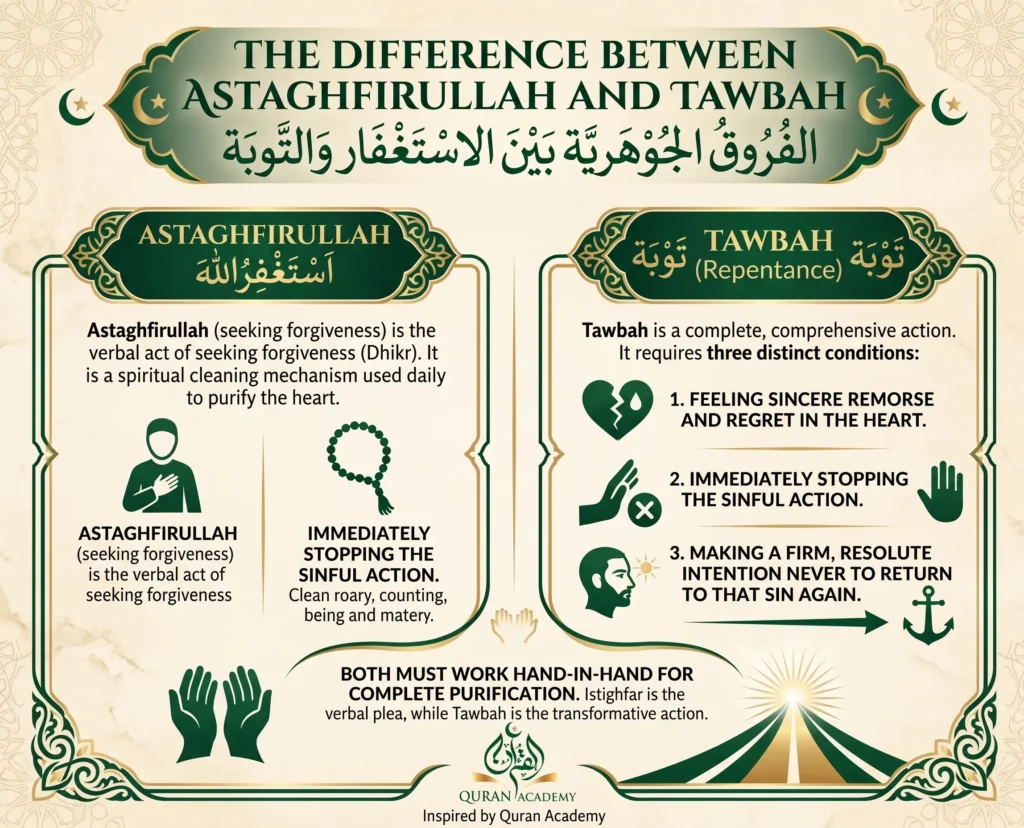
A common question among students of Islamic knowledge is the distinction between Istighfar and Tawbah.
Astaghfirullah (Istighfar): This is the verbal act of seeking forgiveness (Dhikr). It is a spiritual cleaning mechanism used daily to purify the heart.
Tawbah (Repentance): Tawbah is a complete, comprehensive action. It requires three distinct conditions: feeling sincere remorse and regret in the heart, immediately stopping the sinful action, and making a firm, resolute intention never to return to that sin again.
Istighfar is the verbal plea, while Tawbah is the transformative physical and spiritual action. Both must work hand-in-hand for complete purification.
Why Do Muslims Say Astaghfirullah?
This profound phrase is utilized in various aspects of a Muslim’s daily routine:
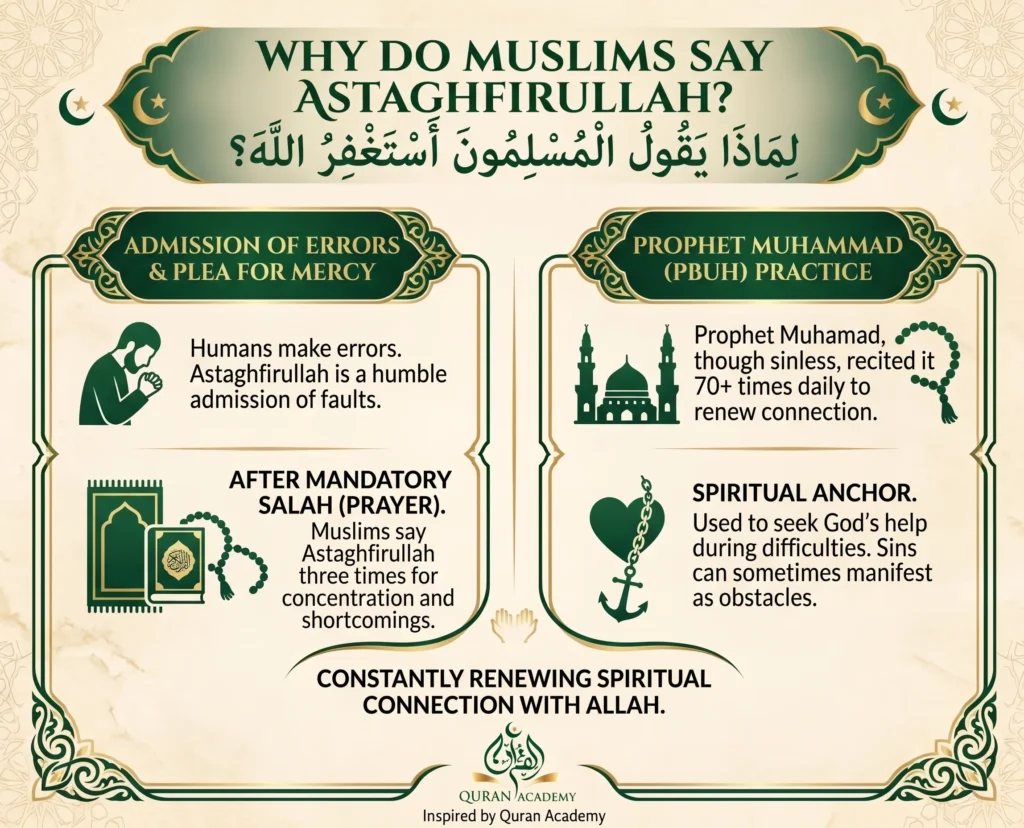
Seeking Forgiveness for Daily Mistakes: Human beings are inherently prone to errors. Saying Astaghfirullah is a humble admission of our faults and a direct plea for God’s mercy.
The Sunnah of the Prophet: Prophet Muhammad (PBUH) was entirely sinless, yet he recited Astaghfirullah more than 70 to 100 times a day. This establishes a powerful Sunnah for all believers to constantly renew their connection with Allah.
After Completing Good Deeds: Interestingly, Muslims are taught to say Astaghfirullah three times immediately after finishing their daily obligatory prayers (Salah). This is to seek forgiveness for any lack of concentration or shortcomings during the worship itself.
During Moments of Stress and Anxiety: The phrase serves as a spiritual anchor. It is widely used to seek God’s help during difficulties, as unrepented sins can sometimes manifest as obstacles in life.
The Transformative Benefits of Istighfar in Quran
The benefits of istighfar in quran are vast and encompass both spiritual rewards and worldly provisions. In Surah Nuh (71:10-12), Prophet Nuh advises his people regarding the incredible power of seeking forgiveness:
“And said, ‘Ask forgiveness of your Lord. Indeed, He is ever a Perpetual Forgiver. He will send [rain from] the sky upon you in [continuing] showers. And give you increase in wealth and children and provide for you gardens and provide for you rivers.'”
This clearly outlines that consistent Istighfar unlocks:
Relief from financial burdens and an increase in lawful wealth (Rizq).
Blessings in offspring and family life.
The removal of anxiety, bringing immense psychological peace.
Rain and agricultural prosperity during times of drought.
Types of Istighfar: Finding the Best Dua
There are several types of istighfar ranging from short, daily phrases to profound, comprehensive prayers found in the Sunnah.
1. The Short, Daily Istighfar
The most common and easy to memorize is simply saying: “Astaghfirullah” (I seek forgiveness from Allah).
2. The Comprehensive Istighfar
A highly recommended istighfar dua in arabic that offers immense rewards is:
أَسْتَغْفِرُ اللَّهَ الْعَظِيمَ الَّذِي لاَ إِلَهَ إِلاَّ هُوَ الْحَيُّ الْْقَيُّومُ وَ أَتُوبُ إِلَيْهِ Transliteration: “Astaghfirullah al-‘Azeem al-lathee laa ilaaha illaa Huwal-Hayyul-Qayyoomu wa atoobu ilayh.” Meaning: “I seek the forgiveness of Allah the Almighty, Whom there is none worthy of worship except Him, the Living, the Eternal, and I repent to Him.”
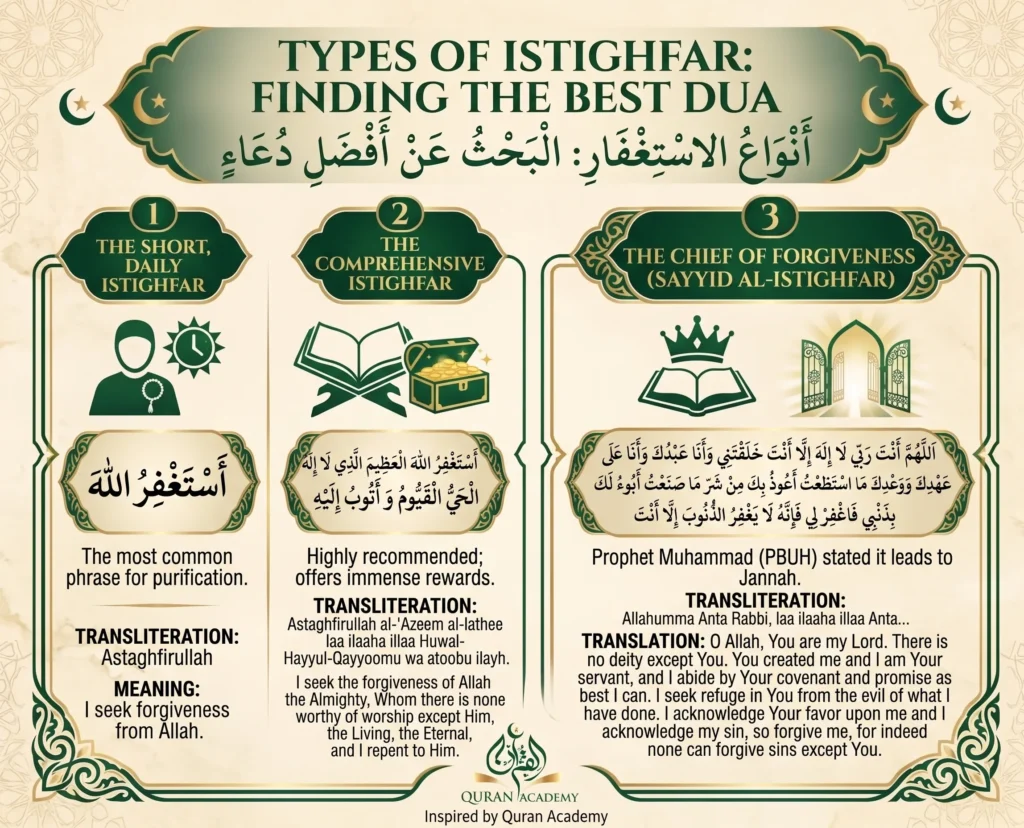
3. The Chief of Forgiveness (Sayyid al-Istighfar)
When searching for the best istighfar for forgiveness or the best astaghfirullah dua, scholars unanimously point to Sayyid al-Istighfar (The Master of Supplications for Forgiveness). The Prophet (PBUH) stated that whoever recites this with certainty during the day and dies before evening, or recites it at night and dies before morning, will be among the people of Paradise (Jannah).
اللَّهُمَّ أَنْتَ رَبِّي لا إِلَهَ إِلا أَنْتَ خَلَقْتَنِي وَأَنَا عَبْدُكَ وَأَنَا عَلَى عَهْدِكَ وَوَعْدِكَ مَا اسْتَطَعْتُ أَعُوذُ بِكَ مِنْ شَرِّ مَا صَنَعْتُ أَبُوءُ لَكَ بِنِعْمَتِكَ عَلَيَّ وَأَبُوءُ لَكَ بِذَنْبِي فَاغْفِرْ لِي فَإِنَّهُ لا يَغْفِرُ الذُّنُوبَ إِلا أَنْتَ Translation: “O Allah, You are my Lord. There is no deity except You. You created me and I am Your servant, and I abide by Your covenant and promise as best I can. I seek refuge in You from the evil of what I have done. I acknowledge Your favor upon me and I acknowledge my sin, so forgive me, for indeed none can forgive sins except You.”
The Best Astaghfar in Quran
Beyond the Prophetic traditions, Muslims often seek an astaghfirullah dua in quran. The Quran contains powerful supplications made by Prophets during their most vulnerable moments. The best astaghfar in quran includes:
The Dua of Prophet Adam and Hawa (Eve): “Our Lord, we have wronged ourselves, and if You do not forgive us and have mercy upon us, we will surely be among the losers.” (Surah Al-A’raf, 7:23).
The Dua of Prophet Yunus (Jonah) in the Whale: “There is no deity except You; exalted are You. Indeed, I have been of the wrongdoers.” (Surah Al-Anbya, 21:87). This is considered a supreme form of repentance through the glorification of Allah.
Will Allah Forgive Me If I Say Astaghfirullah?
A common concern for believers facing the weight of their mistakes is whether Allah will truly accept their apology. The answer is resoundingly yes. Allah refers to Himself as Al-Ghaffar (The Perpetual Forgiver) and At-Tawwaab (The Ever-Acceptor of Repentance).
No matter the magnitude of the sin, if a believer says Astaghfirullah with a genuine heart, expresses deep remorse, and strives resolutely to improve their actions, Allah’s forgiveness is guaranteed. Despair is viewed as a trick of the devil (Shaytan) designed to pull the believer away from the mercy of the Creator.
Deepen Your Connection with Quran Academy
Understanding the precise meanings of Quranic verses, properly pronouncing the istighfar dua in arabic, and incorporating these profound Islamic concepts into your daily life requires structured, professional guidance.
At Quran Academy, our company is dedicated to providing high-quality, comprehensive online Islamic education. Our expert native Arabic instructors offer tailored courses in Quranic Recitation, Tajweed, and Islamic Studies to help you and your family achieve spiritual excellence and a deeper understanding of Allah’s magnificent words.
Embark on your journey of spiritual purification today. Book your free trial class here: https://quraan-academy.com/free-trial/
Frequently Asked Questions (FAQs)
The actual meaning of “Astaghfirullah” is “I seek forgiveness from Allah.” It is derived from the Arabic root word indicating protection and covering. It is a humble, daily plea used by Muslims to ask God to pardon their sins, cover their faults, and grant them spiritual purity.
“Subhanallah” translates to “Glory be to Allah” or “Allah is free from any imperfection.” It is said during daily Adhkar (remembrance), during prayers, or as an expression of awe, amazement, or shock when witnessing something beautiful, extraordinary, or surprising in Allah’s creation.
Surah Muhammad (47:4) discusses the rules of engagement and the treatment of prisoners of war during the early, defensive battles of Islam. However, in the context of seeking forgiveness, a much more relevant verse in the same chapter is Surah Muhammad (47:19), which states: “So know, [O Muhammad], that there is no deity except Allah and ask forgiveness for your sin and for the believing men and believing women…”
Before going to sleep, it is a highly recommended Sunnah (known as the Tasbeeh of Fatimah) to recite: “Subhanallah” (Glory be to Allah) 33 times, “Alhamdulillah” (All praise is due to Allah) 33 times, and “Allahu Akbar” (Allah is the Greatest) 34 times. The Prophet (PBUH) taught that this practice provides more strength and comfort than having a physical servant to help with daily exhaustion.




You have mentioned very interesting points! ps decent web site.
Very neat blog article.Thanks Again.