Al Rahman Al Rahim Meaning: Understanding Allah's Boundless Mercy - Quran Academy
The Arabic phrase “Bismillahir Rahmanir Rahim” (بِسْمِ ٱللَّٰهِ ٱلرَّحْمَٰنِ ٱلرَّحِيمِ) is the most repeated sentence in the daily life of a Muslim. From waking up and eating to embarking on new endeavors and reciting the Holy Quran, Muslims across the USA, UK, Canada, and Australia utter these profound words to seek divine blessings. But what is the profound depth behind the ar-rahman ar rahim meaning?
These two majestic names of Allah—Al-Rahman and Al-Raheem—are the absolute foundation of how Muslims understand the Creator. They do not merely translate to “The Merciful”; they represent the vast, all-encompassing, and continuous compassion that sustains the entire universe. This comprehensive guide explores the exact linguistic roots, the theological differences, and the practical daily applications of these divine attributes.
What is the Meaning of Al Rahman Al Rahim?
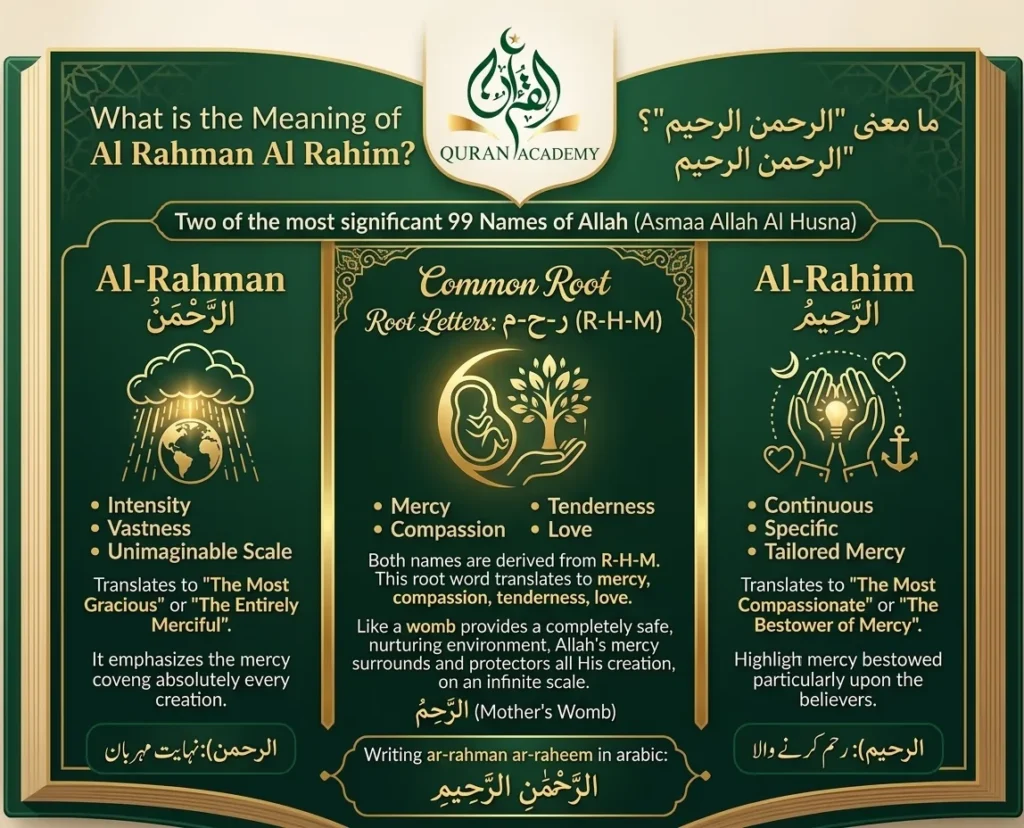
When we explore the ar-rahman ar rahim meaning, we are looking at two of the most significant names among the 99 Names of Allah (Asmaa Allah Al Husna).
Al-Rahman (الرَّحْمَٰنُ): Translates to “The Most Gracious” or “The Entirely Merciful.” It emphasizes the sheer intensity, vastness, and unimaginable scale of Allah’s mercy that covers absolutely every creation.
Al-Rahim (الرَّحِيمُ): Translates to “The Most Compassionate” or “The Bestower of Mercy.” It highlights the continuous, specific, and tailored mercy that Allah bestows, particularly upon the believers.
Both names are derived from the same root letters in Arabic: R-H-M (ر-ح-م). This root word translates to mercy, compassion, tenderness, and love. Profoundly, the Arabic word for the mother’s womb (Rahm) is derived from this exact same root. Just as a womb provides a completely safe, nurturing, and unconditional environment for an unborn child, Allah’s mercy surrounds, protects, and sustains all of His creation, but on a majestically infinite scale.
To write ar-rahman ar-raheem in arabic, it is rendered as الرَّحْمَٰنِ الرَّحِيمِ. For our South Asian readers seeking the ar-rahman meaning in urdu, it translates to “نہایت مہربان” (Extremely Merciful), while Ar-Raheem is “رحم کرنے والا” (The Continuously Merciful).
Al Rahman vs Al-Raheem: The Core Differences
A common question among students of Islamic theology is: If both names mean merciful, why are they used together? The answer lies in the al rahman vs al-raheem comparison. They are not repetitive; they are perfectly complementary.
1. The Ar-Rahman Meaning: Universal and Immense
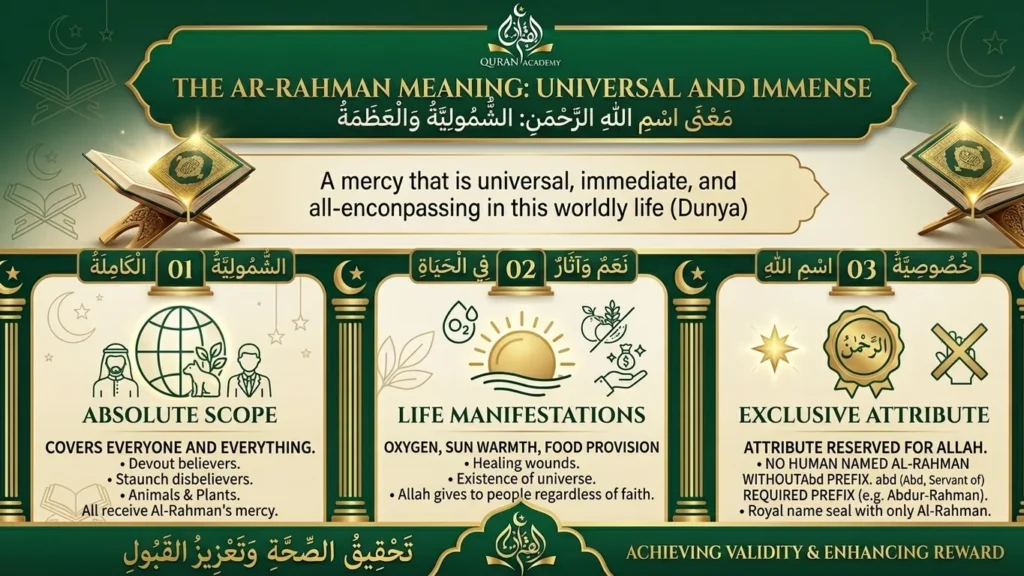
The ar-rahman meaning signifies a mercy that is universal, immediate, and all-encompassing in this worldly life (Dunya).
Scope: It covers absolutely everyone and everything. It does not matter if a person is a devout believer, a staunch disbeliever, an animal, or a plant—they all receive the mercy of Al-Rahman.
Examples in Life: The oxygen we breathe, the warmth of the sun, the provision of food, the healing of wounds, and the very existence of the universe are all manifestations of Al-Rahman. Allah gives wealth, health, and joy to people regardless of their faith because He is Al-Rahman.
Exclusivity: This attribute is incredibly intense. Because its vastness is so absolute, the name “Al-Rahman” can strictly only be used for Allah. No human being can be named Al-Rahman without the prefix “Abd” (Servant of), making it Abdur-Rahman.
2. The Ar-Raheem Meaning: Specific and Continuous
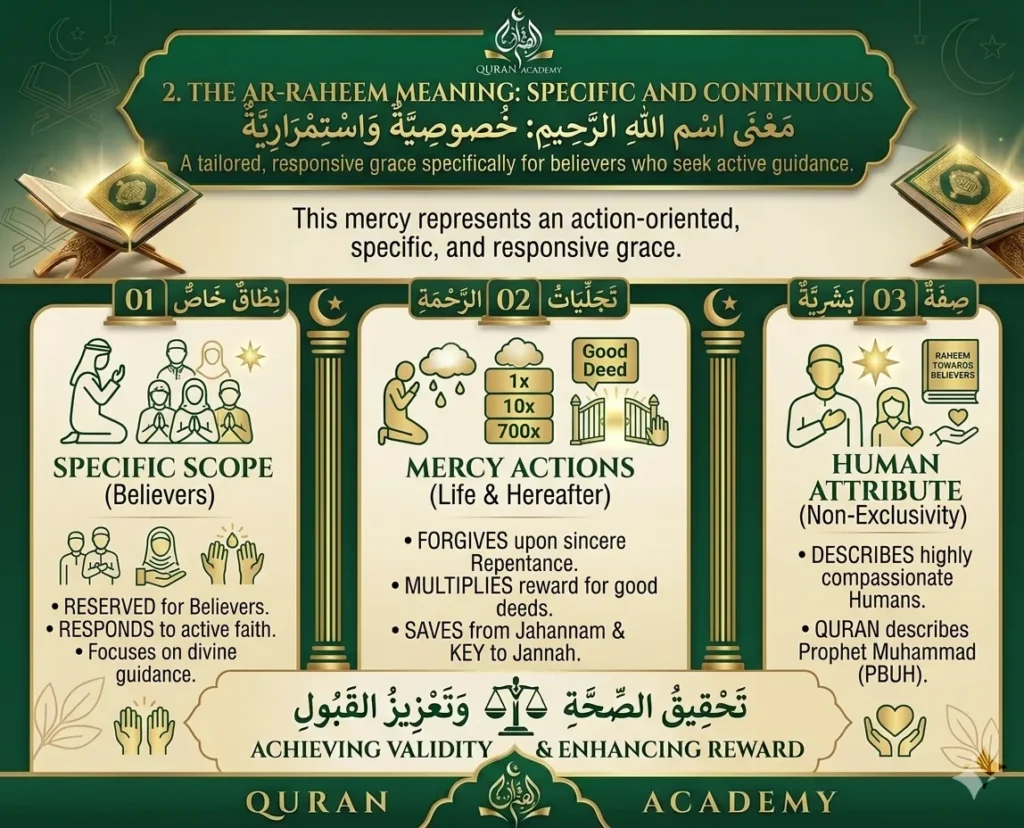
The ar-raheem meaning represents an action-oriented, continuous, and tailored mercy.
Scope: This mercy is specially reserved for the believers who actively seek Allah’s guidance. It is a mercy that responds to a believer’s actions.
Examples in Life and the Hereafter: When you commit a sin and sincerely repent, it is Al-Raheem who forgives you. When you perform a good deed and Allah multiplies its reward, that is the action of Al-Raheem. Most importantly, the mercy required to enter Paradise (Jannah) and be saved from the Hellfire (Jahannam) on the Day of Judgment is the specific mercy of Al-Raheem.
Non-Exclusivity: Unlike Al-Rahman, the term “Raheem” can be used to describe human beings who are highly compassionate. In fact, the Quran describes Prophet Muhammad (PBUH) as Raheem towards the believers (Surah At-Tawbah 9:128).
In summary of al rahman vs al-raheem: Al-Rahman is the nature of His immense mercy covering all creation today, while Al-Raheem is the action of His continuous mercy rewarding the believers tomorrow.
How Many Times is Ar-Raheem Mentioned in the Quran?
Students often ask, how many times ar-raheem mentioned in quran? The emphasis on Allah’s mercy in the Holy Book is astonishing. The name Ar-Raheem is mentioned a staggering 114 times strictly as part of the Basmalah (Bismillahir Rahmanir Rahim) at the beginning of the Surahs (113 at the openings, and once inside Surah An-Naml). Furthermore, independently as a divine attribute, the word Raheem appears over 114 times throughout the Quranic text, frequently paired with other names like Al-Ghafoor (The Forgiving). This high frequency serves as a constant, reassuring reminder to humanity never to despair of God’s forgiveness.
Balancing Mercy with Sovereignty: The Al-Malik Meaning
While the Quran overwhelmingly emphasizes mercy, it maintains a perfect theological balance. Right after mentioning Al-Rahman and Al-Raheem in Surah Al-Fatiha, Allah declares Himself as Maliki Yawm Ad-Din (Master of the Day of Judgment).
Understanding the al-malik meaning is crucial here. Al-Malik translates to “The Eternal Lord,” “The Sovereign,” or “The King.” It reminds believers that while Allah is infinitely merciful, He is also the ultimate judge and ruler. His mercy does not negate His absolute justice. This perfect balance prevents believers from becoming complacent in their sins while simultaneously preventing them from losing hope.
Why Bismillah Al Rahman Al Rahim is Significant
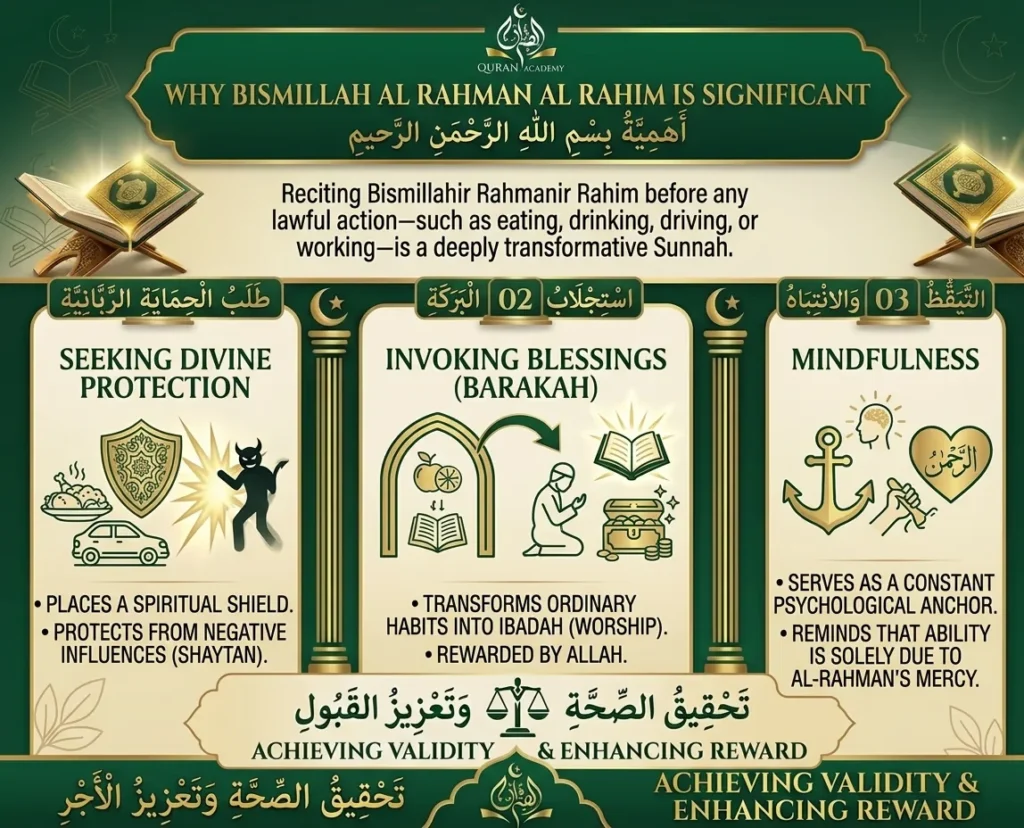
Reciting Bismillahir Rahmanir Rahim before any lawful action—such as eating, drinking, driving, or working—is a deeply transformative Sunnah.
Seeking Divine Protection: It places a spiritual shield over the action, protecting it from negative influences (Shaytan).
Invoking Blessings (Barakah): It transforms an ordinary, mundane habit (like eating or studying) into an active form of worship (Ibadah) that is rewarded by Allah.
Mindfulness: It serves as a constant psychological anchor, reminding the Muslim that their ability to perform the task is solely due to the mercy of Al-Rahman.
How to Apply Al Rahman Al Rahim in Daily Life
Understanding these divine attributes should directly impact human behavior. Prophet Muhammad (PBUH) stated: “Those who are merciful will be shown mercy by the Most Merciful. Be merciful to those on the earth, and the One in the heavens will have mercy upon you.” (Sunan Abi Dawud).
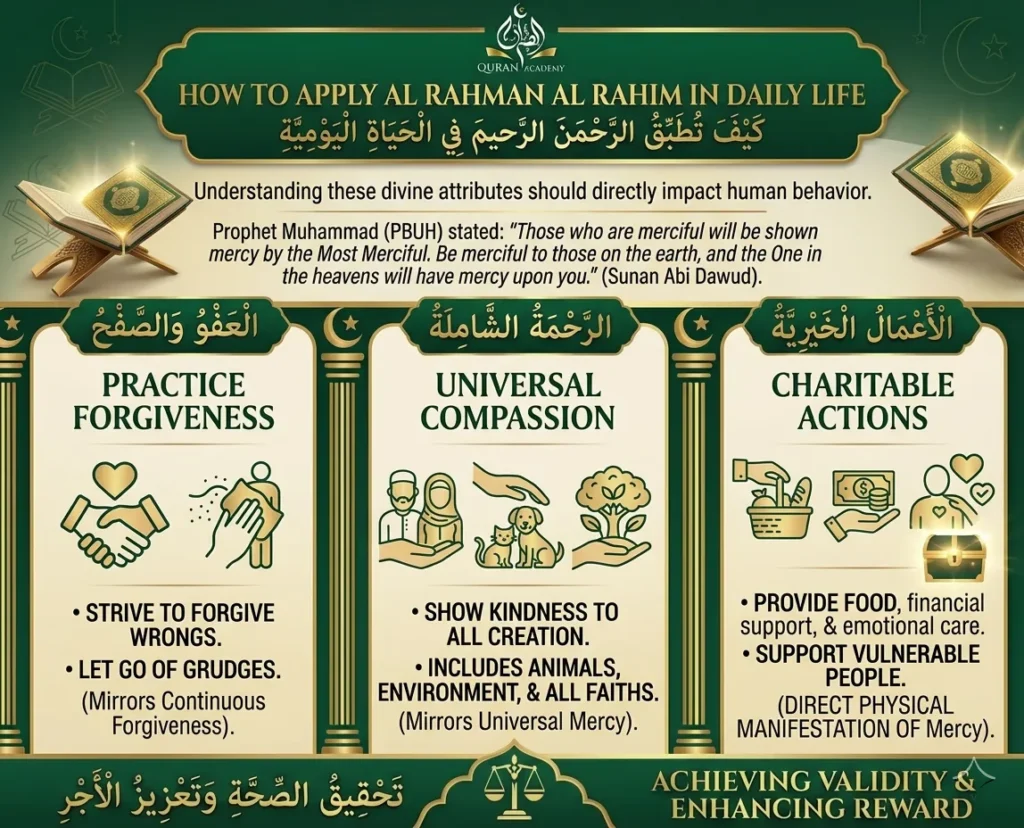
Practice Forgiveness: Just as Allah continuously forgives (Al-Raheem), believers must strive to forgive those who wrong them, letting go of grudges.
Universal Compassion: Mirroring the universal mercy of Al-Rahman, Muslims must show kindness to all of creation, including animals, the environment, and people of different faiths.
Charitable Actions: Providing food, financial support, and emotional care to the vulnerable is a direct physical manifestation of understanding God’s mercy.
Master the Beautiful Names of Allah with Quran Academy
To truly comprehend the depth of the Arabic language, the precise meanings of the Quran, and the majestic attributes of Allah, structured learning is essential.
At Quran Academy, we empower Muslims across the globe to connect deeply with their Creator. Our highly qualified, native Arabic instructors provide interactive, professional online courses in Quranic Recitation, Tajweed, Islamic Theology (Aqeedah), and Arabic language mastery.
Unlock the treasures of the Quran today. Book your completely free trial class right here: https://quraan-academy.com/free-trial/
Frequently Asked Questions (FAQs)
“Al-Rahman” means The Most Gracious or The Entirely Merciful, representing Allah’s vast, universal mercy that encompasses all of creation in this world. “Al-Rahim” means The Most Compassionate or The Bestower of Mercy, representing His specific, continuous, and tailored mercy reserved for the believers, especially in the Hereafter.
In the Quran, Al-Rahman is one of the most prominent and exclusive names of Allah. It signifies an intensity of mercy that is so immense and absolute that it sustains the very existence of the universe. It guarantees provision, oxygen, and life to all creatures, regardless of their belief or disobedience.
The phrase “La hawla wa la quwwata illa billah” translates to: “There is no power nor strength except by Allah.” It is a profound declaration of absolute reliance on God, acknowledging that a person cannot change a situation from bad to good, nor find the strength to do good deeds, without the direct help and will of Allah.
Saying “Oh my god” is not strictly haram (forbidden) if it is used merely as an expression of surprise without any intention of associating partners with Allah. However, Muslims are strongly encouraged to replace such secular expressions with Islamic Dhikr. Instead of “Oh my god,” it is far more rewarding and mindful to say “SubhanAllah” (Glory be to God), “Allahu Akbar” (God is the Greatest), or simply “Ya Allah.”


I don’t unremarkably comment but I gotta admit thanks for the post on this perfect one : D.