

Table of Contents
ToggleThe Ultimate Guide to Mastering the Basics of Quran Recitation
The Holy Quran is a profound source of guidance, peace, and divine inspiration for millions around the world. However, for non-Arabic speakers living in Western countries, the idea of reading the Quran in its original language can initially feel like an overwhelming mountain to climb.
If you are wondering where to start, you are in the right place. Mastering the basics of Quran recitation is a beautiful, step-by-step journey. This comprehensive guide will walk you through the essential steps to confidently read, understand, and connect with the words of Allah, transforming your apprehension into profound spiritual joy.
10 Essential Steps to Master Basic Quran Reading
Building a strong foundation is the secret to lifelong success. Here is your roadmap to mastering the basics of Quran recitation:
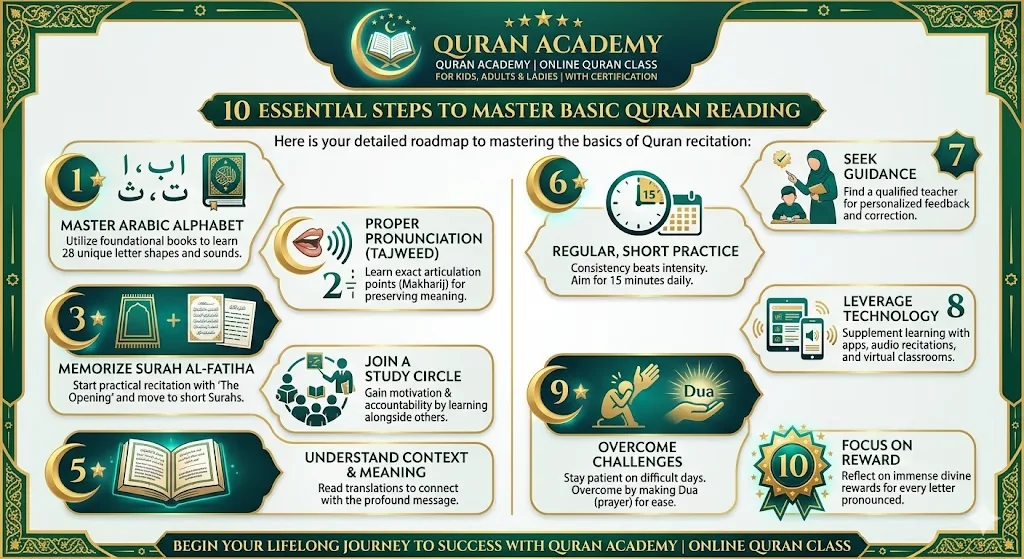
3. Memorize Surah Al-Fatiha and Short Surahs
Start your practical recitation with Surah Al-Fatiha (The Opening). This chapter is the heart of every daily prayer (Salah) and introduces you to the basic rhythm of Quranic recitation. Once comfortable, gradually move on to shorter, easier chapters from the end of the Quran, such as Surah Al-Ikhlas, Al-Falaq, and An-Nas.
5. Understand the Context and Meaning
Reciting without understanding is like reading a letter in a foreign language; you miss the emotional impact. Reading the Quran in basic English translation alongside your Arabic practice helps you understand the historical context and the profound meanings of the verses you are working hard to recite.
7. Seek Guidance from a Qualified Teacher
Self-learning has its limits, especially with pronunciation. Finding a qualified, native-speaking Quran teacher is crucial. They will provide personalized feedback, correct subtle mistakes you cannot hear yourself, and guide your progression safely.
9. Overcome Challenges with Patience
You will face days where a specific rule feels too hard or you forget a verse. This is completely normal. Overcome these challenges by making sincere Dua (prayer) for ease, taking a short break, and remembering that Allah rewards you double for the effort it takes to struggle through reading.
1. Master the Arabic Alphabet
The Quran was revealed in Arabic, making the alphabet your absolute first step. You cannot run before you learn to walk. Utilize foundational books like the Noorani Qaida, which is specifically designed for beginners to familiarize themselves with the 28 Arabic letters, their unique shapes in different positions, and their fundamental sounds.
2. Acquire Proper Pronunciation (Tajweed)
Once you know the letters, you must learn exactly how to say them. This is the science of Tajweed. It involves knowing the articulation points (Makharij) of each letter—whether it comes from the throat, the tongue, or the lips. Correct pronunciation ensures that the meaning of the Quran is preserved and beautifully recited.
4. Join a Supportive Quran Study Circle
You do not have to do this alone! Joining a group class or an online community provides immense motivation and accountability. Learning alongside other beginners reminds you that making mistakes is a normal part of the process, and sharing progress keeps your spiritual energy high.
6. Commit to Regular, Short Practice
Consistency always beats intensity. Practicing your basic Quran reading for just 15 minutes every single day builds muscle memory and fluency much faster than attempting a exhausting two-hour session once a week.
8. Leverage Modern Technology
Take advantage of the digital age! Use interactive apps, audio recitations by famous Qaris, and digital platforms like the virtual classrooms at Quran Academy to supplement your learning visually and auditorily.
10. Focus on the Ultimate Reward
Always remember your “Why.” Conclude your daily practice by reflecting on the immense rewards of reciting the Quran. Every single letter you struggle to pronounce carries a divine reward, elevating your status in this life and the hereafter.
Discovering the Most Common Arabic Words in the Quran
Did you know that a relatively small number of words make up a massive percentage of the entire Quran? By familiarizing yourself with the most common Arabic words in the Quran, you can rapidly accelerate your understanding.
Here are a few fundamental words to start building your vocabulary:
الله (Allah): God
الرحمن (Ar-Rahman): The Most Gracious
الرحيم (Ar-Rahim): The Most Merciful
الناس (An-Nas): Mankind / People
قال (Qala): He said
إن (Inna): Indeed / Truly
و (Wa): And
في (Fi): In
من (Min): From
إلى (Ila): To
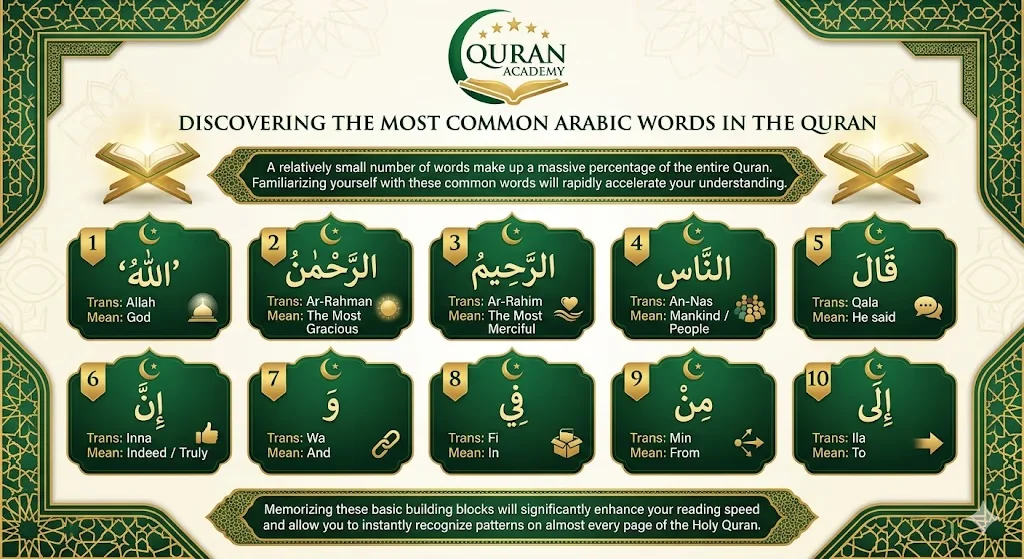
Memorizing just these basic building blocks will significantly enhance your reading speed and allow you to instantly recognize patterns on almost every page of the Holy Quran.
The Importance of Basic Quranic Arabic Grammar
While you don’t need to become a linguistic scholar to read the Quran, understanding basic Quranic Arabic grammar is incredibly beneficial.
Arabic is a root-based language. Knowing simple grammar rules helps you identify how words are connected, whether a word is past or present tense, and who is being addressed. This basic grammatical foundation bridges the gap between simply making sounds and actually comprehending the divine message, making your daily recitation deeply fulfilling.
Kickstart Your Learning Journey Today
Mastering the basics of Quran is a highly rewarding spiritual endeavor. Understanding key concepts, building your vocabulary, and practicing proper recitation sets a rock-solid foundation for a lifetime of connection with the holy text.
Whether you are an absolute beginner seeking knowledge or someone looking to correct your existing reading, Quran Academy is here to guide you step-by-step with expert, supportive instructors.
Ready to embark on this enlightening journey?
Frequently Asked Questions (FAQs)
Reading the Quran in basic English refers to using clear, easy-to-understand English translations of the Quranic text. While the Quran must be recited in its original Arabic during prayers, using a basic English translation alongside your studies is highly recommended for beginners. It makes the profound teachings, historical context, and divine messages fully accessible to non-Arabic speakers.
To quickly boost your basic Quran reading skills, focus on consistency rather than duration. Practice reciting for 15 minutes daily. Listen to clear audio recitations by expert Qaris and repeat after them to improve your fluency. Most importantly, enlist the help of a qualified online teacher who can provide personalized corrections and ensure you are not memorizing mistakes.
Understanding basic Quranic Arabic grammar is the key to unlocking the actual meaning behind the sounds you are making. Grasping simple rules—like identifying pronouns, past/present tense verbs, and sentence structures—allows you to interpret the verses accurately. It transforms your recitation from a mechanical exercise into a deeply spiritual and intellectual conversation with the text.
A surprisingly small vocabulary makes up a large portion of the Quran. Some of the most common Arabic words in the Quran include “Rahman” (The Most Gracious), “Rahim” (The Most Merciful), “Dunya” (Worldly life), “Jannah” (Paradise), “Nafs” (Soul), and basic prepositions like “Fi” (In) and “Min” (From). Mastering these frequent words drastically improves your basic comprehension.
You can enhance your knowledge by taking a holistic approach: combine daily recitation practice with studying the Noorani Qaida, learning the most common vocabulary words, and reading a reliable Tafsir (explanation) in English. Enrolling in a structured beginner’s course at a reputable platform like Quran Academy ensures you build this foundational knowledge correctly and systematically.



Hi there, simply become alert to your blog via Google, and found that it is truly informative. I am going to watch out for brussels. I will be grateful if you happen to continue this in future. Lots of folks can be benefited out of your writing. Cheers!
Really enjoyed this blog post.Really looking forward to read more. Great.
This is the precise weblog for anyone who wants to seek out out about this topic. You understand a lot its almost exhausting to argue with you (not that I really would need…HaHa). You undoubtedly put a brand new spin on a topic thats been written about for years. Nice stuff, simply nice!